Skip to content
OA

AI/ML Engineer · Biomedical Engineering

Ohidul Alam

Engineering intelligence.Exploring biology.

AI/ML engineer and Biomedical Engineering student at KUET, building deep learning systems for medical imaging, EEG biosignals, computer vision and genomic data.
  • Meherpur, Khulna, Bangladesh
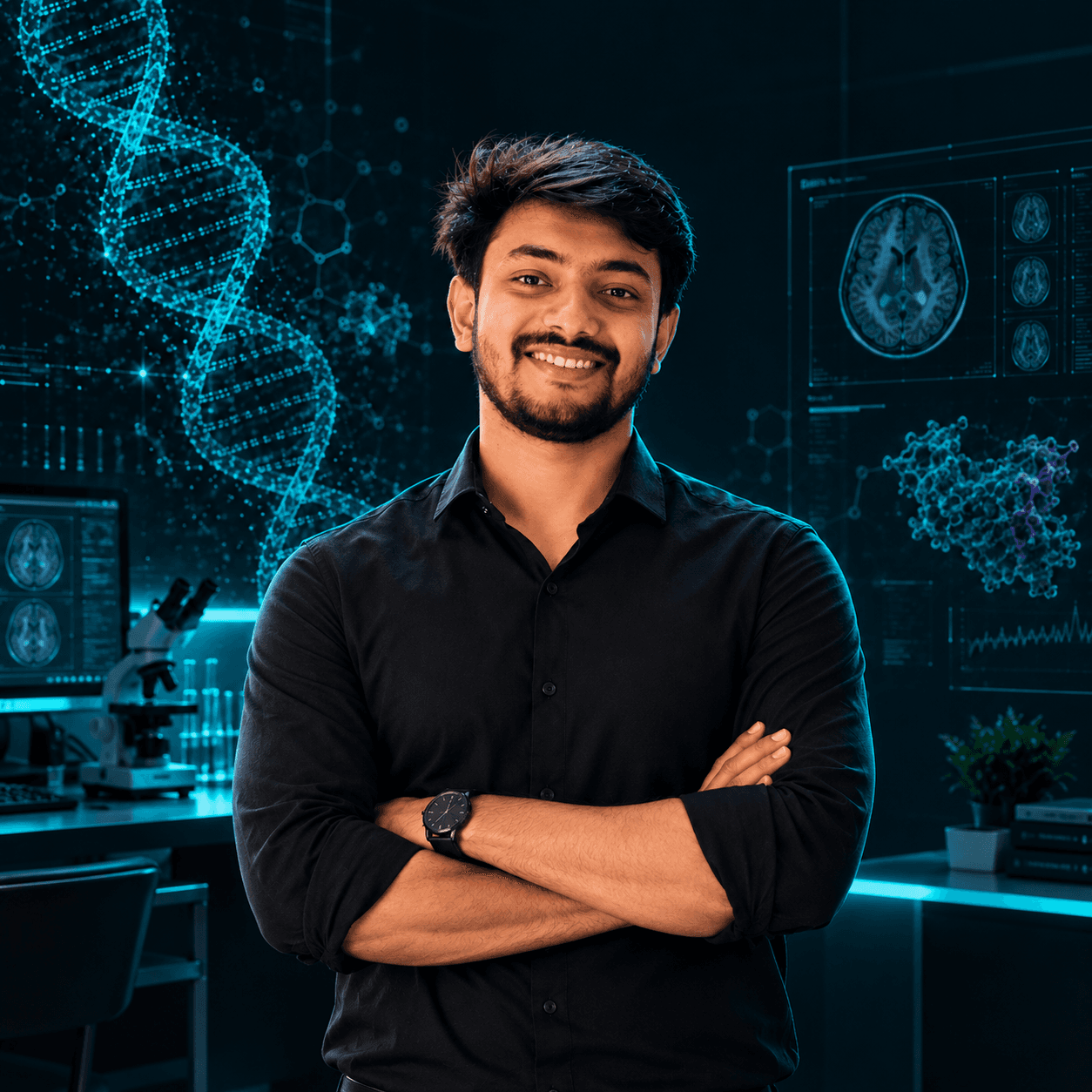
Portrait of Ohidul Alam
Projects
Live medical AI apps
Research directions
Years at KUET

01About

Where biology meets machine learning

Biomedical engineer with hands-on experience in deep learning, computer vision, generative AI, EEG/biosignal analysis and genomic data modeling, seeking an AI/ML or Data Analytics role to build intelligent, data-driven solutions that turn complex data into real-world impact.

My background is Biomedical Engineering at Khulna University of Engineering & Technology (KUET, 2022–2026), with hands-on work across medical AI, clinical imaging, EEG-based brain-computer interfaces, computer vision, generative AI and bioinformatics.

As President of KUET Research Society and a FabLab operator, I have led teams, guided students and collaborated across disciplines.

Focus areas

01
Medical imaging & clinical AI
Brain tumor segmentation from MRI, prescription OCR
02
EEG / biosignals
Brain–computer interface for patient intent prediction
03
Computer vision
YOLO-based detection with Global Attention Mechanism
04
Genomics
RNA structure and function prediction

Certifications

  • Deep Learning Certification — Great Learning
  • 100% Attendance Certificate — Awarded by KUET for full attendance in 2 semesters
  • Hands-on Training using Fabrication Tools — FabLab KUET

Skills & abilities

Programming
PythonJavaScriptMATLABCR
Machine & deep learning
PyTorchTensorFlowScikit-learnVision Transformer (ViT)YOLOAlexNetEfficientNetONNXTensorFlow LiteLangChainLangGraphLangSmithFastAPI
Computer vision
OpenCVImage ProcessingObject Detection
Data & analytics
Big Data AnalysisAutomated Report GenerationSpeech/Voice Synthesis
Software & tools
Google ColabKaggle NotebooksStreamlitFlaskROSPowerPoint
Domain knowledge
Biomedical engineeringMedical imaging & clinical AIEEG/biosignal processingBioinformaticsHealthcare technology

02Projects

Selected works

Two deployed medical AI applications, shown as live 3D schematics. More projects from my CV are listed further down.

Conceptual 3D illustration · not a screenshot of the app

Project 01Medical NLP · Clinical AI

AIMScribe

Clinical NLP Recommender

A deployed clinical NLP recommender application, hosted on Streamlit. Open the live app to see exactly what it does.

  • Python
  • NLP
  • Streamlit
Interface map · module names from the live app · not a screenshot

Project 02Medical AI · Conversational assistant

Medical AI Assistant

Smart AI — Advanced Medical Assistant

A deployed web assistant that combines AI chat with voice consultation, symptom analysis, medical image analysis, wearable vitals, mental-health screening, medication reminders and more.

  • Voice consultation with speech transcription in multiple languages and browser read-aloud
  • Symptom analyzer and medical image analysis (X-ray, MRI, CT, ultrasound) for informational use
  • Smartwatch vitals via Web Bluetooth, plus manual vitals entry
  • PHQ-9 and GAD-7 screening, mood journal, medication reminders and pill identification
  • Emergency SOS with an OpenStreetMap hospital locator, nutrition planner, drug-interaction checker, health-record analyzer and risk assessments
  • Groq AI APIs
  • Web Bluetooth
  • OpenStreetMap
  • Browser TTS & Notifications

03Research

Research directions

Areas I have applied deep learning to, as described in my CV. Entries are labeled by status. No publications, results or citations are claimed.

  • Published
  • Ongoing research
  • Proposed idea
  • Applied project · unpublished

R–01

EEG-based brain–computer interface for patient intent prediction

Applied project · unpublished

Project work described in the CV. No publication is claimed.

  • EEG
  • Biosignals
  • Deep learning
  • BCI
Live 3D EEG channels · synthetic signal · not experimental data
Research question
Can deep learning on EEG signals decode what a patient who cannot speak is trying to communicate?
Methodology
Deep learning applied to EEG biosignals to predict communication intent, bridging biological intelligence and AI.
Results
No verified results reported.
Limitations
Datasets, model architecture and evaluation metrics are not stated in the CV and are therefore not reported here.
Future directions
To be documented when a verified write-up is available.

R–02

Brain tumor segmentation from MRI scans

Applied project · unpublished

Part of the 'Medical AI: Prescription OCR + Brain Tumor Detection' project in the CV.

  • Medical imaging
  • Segmentation
  • MRI
Live 3D MRI slice scan · schematic · not experimental data
Research question
Can a deep learning pipeline segment brain tumors from MRI to support faster, more accurate clinical decisions?
Methodology
Deep learning segmentation pipeline applied to MRI scans.
Results
No verified results reported.
Limitations
No segmentation metrics, datasets or clinical validation are stated, so none are reported. Not a diagnostic tool.
Future directions
To be documented when a verified write-up is available.

R–03

Genome / RNA structure and function prediction

Applied project · unpublished

Project work described in the CV. No publication is claimed.

  • Bioinformatics
  • Genomics
  • RNA
  • Deep learning
Live 3D RNA/DNA helix · schematic · not experimental data
Research question
Can deep learning on genomic sequences predict structural and functional RNA properties?
Methodology
Deep learning applied to genomic sequences to predict structural and functional RNA properties.
Results
No verified results reported.
Limitations
Models, datasets and benchmarks are not stated in the CV and are therefore not reported here.
Future directions
To be documented when a verified write-up is available.

04Experience

Experience, education & leadership

Taken from my CV. Dates appear only where the CV states them.

01

Experience

Work & lab roles · 02

Role 01

Visual Content Manager

Global Travel Platform

  • Managed visual content operations for a global travel platform.
  • Ensured content quality, consistency, and compliance with platform standards.
  • Streamlined content publishing workflows by collaborating with cross-functional teams.
Role 02

Student Operator

FabLab, KUET

  • Operated 3D printers, laser cutters and CNC machines.
  • Guided students on fabrication tools for engineering projects.
02

Education

Degrees & schooling · 02

Undergraduate

2022 – 2026

B.Sc. in Biomedical Engineering

Khulna University of Engineering & Technology (KUET)

Higher secondary

Higher Secondary Education

Gangni Govt. Degree College

03

Leadership

Societies & teams · 03

President

KUET Research Society (KRS)

Autonomous Lead

Team Durbar (KUET Mars Rover)

Vice President

TRY KUET

05Technical Lab

How I think about ML systems

Interactive notes on system design and signal processing. Diagrams are generic illustrations, and the signal bench runs on synthetic data.

A · System patterns

Input → Preprocessing → Model Inference → Post-processing → Output

Input

Raw data enters the system.

  • Examples: an image, an EEG segment, a text string or a genomic sequence.
  • Validate type, size and shape before anything else runs.

Illustrative diagram · generic pattern · not a specific project

B · Signal smoothing bench

  • ━ noisy input
  • ┅ clean reference
  • ━ smoothed output
RMS error, raw
0.555
RMS error, smoothed
0.213

Synthetic data · moving-average filter · not model inference. Try a very large window: it removes noise but also distorts the real signal.

06All Projects

More projects, in detail

Further work from my CV. Each card shows the need it addresses, the general flow of the system and the skills it demonstrates.

  1. Biosignals · Deep learning

    01

    Brain–Computer Interface: EEG-Based Patient Intent Prediction

    An AI-driven BCI that decodes EEG signals to predict what a patient is trying to communicate, giving patients who cannot speak a way to be understood.

    Why it matters

    Patients who cannot speak still have intent. The aim is to read that intent from brain activity so they can be understood without speech.

    General flow

    1. 1EEG recording
    2. 2Filtering & windowing
    3. 3Deep learning model
    4. 4Intent prediction

    What it demonstrates

    • EEG / biosignal preprocessing
    • Time-series deep learning
    • Assistive, patient-centred design
    • EEG
    • Deep learning
  2. Medical imaging · OCR

    02

    Medical AI: Prescription OCR + Brain Tumor Detection

    AI models that digitize handwritten prescriptions via OCR, and a deep learning pipeline that segments brain tumors from MRI scans.

    Why it matters

    Handwritten prescriptions are slow to digitize and MRI review is time-intensive. Both benefit from AI support that is faster and more consistent.

    General flow

    1. 1Scan / image input
    2. 2Preprocessing
    3. 3OCR & segmentation models
    4. 4Digital output

    What it demonstrates

    • Medical image analysis
    • Segmentation of MRI
    • Document OCR for handwriting
    • OCR
    • Deep learning
    • MRI
  3. Generative AI

    03

    AI Content Generation & Conversational Systems

    An AI chatbot with 3D avatar interaction, real-time lip-sync and live call support using LangChain/LangGraph, extended with a diffusion-based pipeline that turns text prompts into images and short videos with live streaming.

    Why it matters

    Conversational systems feel more natural when they can be seen, heard and answered in real time, and when they can create media from plain text.

    General flow

    1. 1User prompt
    2. 2LangChain / LangGraph agent
    3. 33D avatar & lip-sync
    4. 4Live call · image & video output

    What it demonstrates

    • Agent orchestration with LangChain / LangGraph
    • Real-time interaction design
    • Diffusion-based generation
    • LangChain
    • LangGraph
    • Diffusion models
  4. Computer vision

    04

    Real-Time Object Detection & Traffic Intelligence

    YOLO-based systems for real-time detection of vehicles, pedestrians and obstacles for adaptive traffic control, with a Global Attention Mechanism (GAM) integrated into the YOLO architecture to improve accuracy in complex scenes.

    Why it matters

    Fixed-timing traffic control cannot react to what is actually on the road. Detecting vehicles, pedestrians and obstacles lets control adapt.

    General flow

    1. 1Camera frames
    2. 2YOLO + GAM detector
    3. 3Vehicles · pedestrians · obstacles
    4. 4Adaptive traffic control

    What it demonstrates

    • Real-time object detection
    • Attention mechanisms in CNN detectors
    • OpenCV video pipelines
    • YOLO
    • GAM
    • OpenCV
  5. Bioinformatics

    05

    Genome / RNA Structure & Function Prediction

    Deep learning applied to genomic sequences to predict structural and functional RNA properties, supporting biological research.

    Why it matters

    RNA function depends on its structure, which is costly to determine experimentally. Sequence-based prediction can support biological research.

    General flow

    1. 1Genomic sequence
    2. 2Sequence encoding
    3. 3Deep learning model
    4. 4Structure & function prediction

    What it demonstrates

    • Bioinformatics
    • Sequence modeling
    • Applying deep learning to biology
    • Deep learning
    • Genomics
  6. Data analytics

    06

    Big Data Analysis & Automated Report Generation

    A pipeline to process and analyze large datasets and automatically generate structured, decision-ready reports, reducing manual effort.

    Why it matters

    Analysts lose time turning large datasets into readable reports by hand. Automating the path from raw data to a structured report reduces that effort.

    General flow

    1. 1Large datasets
    2. 2Processing & analysis
    3. 3Report generation
    4. 4Decision-ready report

    What it demonstrates

    • Data pipelines in Python
    • Large-scale data analysis
    • Automated, structured reporting
    • Python
    • Data pipelines
  7. Computer vision

    07

    Real-Time Virtual Clothing Try-On

    A real-time virtual try-on system using pose estimation and garment alignment to deliver instant digital outfit previews.

    Why it matters

    Shoppers want to see how clothes look before buying. A live preview that follows the body makes that possible instantly.

    General flow

    1. 1Camera feed
    2. 2Pose estimation
    3. 3Garment alignment
    4. 4Instant outfit preview

    What it demonstrates

    • Pose estimation
    • Real-time computer vision
    • Geometric alignment of overlays
    • Pose estimation
    • Computer vision
  8. Applied vision · Agriculture

    08

    Smartphone Crop Disease Detection & Instant Reporting

    A smartphone-based tool for farmers that detects crop diseases from a photo during cultivation and instantly generates a diagnosis report.

    Why it matters

    Farmers often meet crop disease in the field without quick expert access. A photo-based tool can give a diagnosis report on the spot.

    General flow

    1. 1Phone photo
    2. 2Disease detection
    3. 3Diagnosis report
    4. 4Instant result for the farmer

    What it demonstrates

    • Applied computer vision
    • Mobile-first tooling
    • Turning model output into a readable report
    • Computer vision
    • Mobile
  9. Speech synthesis

    09

    Real-Time Voice Cloning

    A real-time voice cloning system that reproduces a speaker's voice from short audio samples, applying deep learning for speech synthesis.

    Why it matters

    Reproducing a speaker's voice normally needs long recordings. Short samples and deep learning make real-time synthesis practical.

    General flow

    1. 1Short audio sample
    2. 2Speaker representation
    3. 3Speech synthesis
    4. 4Cloned voice in real time

    What it demonstrates

    • Deep learning for speech
    • Voice synthesis
    • Real-time audio processing
    • Deep learning
    • Speech synthesis
  10. Robotics

    10

    Complex Terrain Path Planning (RRT)

    A dynamic RRT-based path-planning algorithm for autonomous navigation in obstacle-rich environments, with real-time avoidance and adaptability to changing terrain.

    Why it matters

    Autonomous robots must move through cluttered, changing terrain. Sampling-based planning finds routes that adapt as obstacles appear.

    General flow

    1. 1Map & obstacles
    2. 2RRT tree expansion
    3. 3Real-time avoidance
    4. 4Path adapted to terrain

    What it demonstrates

    • Rapidly-exploring Random Trees
    • Obstacle avoidance
    • ROS-based robotics
    • RRT
    • Path planning
    • ROS
  11. Robotics

    11

    Line Follow Robotics

    An autonomous robot that follows predefined tracks using sensor feedback and control algorithms, keeping navigation smooth and accurate across variable track conditions.

    Why it matters

    A robot that follows a track must correct itself continuously. Sensor feedback and control keep its motion smooth across changing conditions.

    General flow

    1. 1Sensor readings
    2. 2Control algorithm
    3. 3Motor correction
    4. 4Smooth track following

    What it demonstrates

    • Sensor feedback
    • Control algorithms
    • Embedded autonomy
    • Sensors
    • Control algorithms

Descriptions are generalised from my CV. They show the type of problem and a general system flow, and do not claim specific models, datasets or results.

07Contact

Let's talk

I am looking for AI/ML or Data Analytics roles and research collaborations. Email is the quickest way to reach me.

Based in

Meherpur, Khulna, Bangladesh

This site has no contact form or backend, so there is nothing to submit and no data is collected. Use the links to reach me directly.

Send an email